

Sales Forecasting
Sales Forecasting
Create more dependable sales forecasts for targets, inventory, capacity, cash flow and management decisions.
Sales Forecasting converts transaction, pipeline and market information into a structured view of expected future revenue or volume. The service evaluates seasonality, product mix, geography, customer type, pricing, campaigns and sales-stage behaviour. Forecasts can be developed at different levels and reconciled so executive expectations remain connected to operational plans.
GCC organisations may experience seasonal demand, project-based revenue, tender cycles, promotions, tourism patterns and market-specific events. Forecast design incorporates relevant business drivers and provides scenarios or confidence ranges rather than presenting one unqualified number. Albrandz Technology structures the engagement for organisations operating across Saudi Arabia, the UAE, Qatar, Oman, Bahrain and Kuwait, with clear scope, stakeholder responsibilities, review points, acceptance criteria and knowledge transfer.
What Sales Forecasting Includes
Forecast Objective and Hierarchy
Historical Data and Drivers
Forecast Model
Scenario and Pipeline Analysis
Dashboard and Review Cycle
GCC Delivery Considerations for Sales Forecasting
Analytics delivery in the GCC often spans several systems, departments, projects or operating companies. Before publishing results, organisations need agreed KPI definitions, reconciliation with approved sources, access controls and named data owners. Government reporting may require formal review and traceability, while commercial teams may prioritise speed, forecasting and decision support. In both cases, the solution should preserve a clear link between source data, calculation, visual output and management action. Training and refresh ownership are essential if the analytics is to remain trusted after launch.
Our Sales Forecasting Delivery Approach
The engagement is managed through clear stages and review gates. The exact activities are tailored to the confirmed scope, but a typical Sales Forecasting assignment follows the approach below:
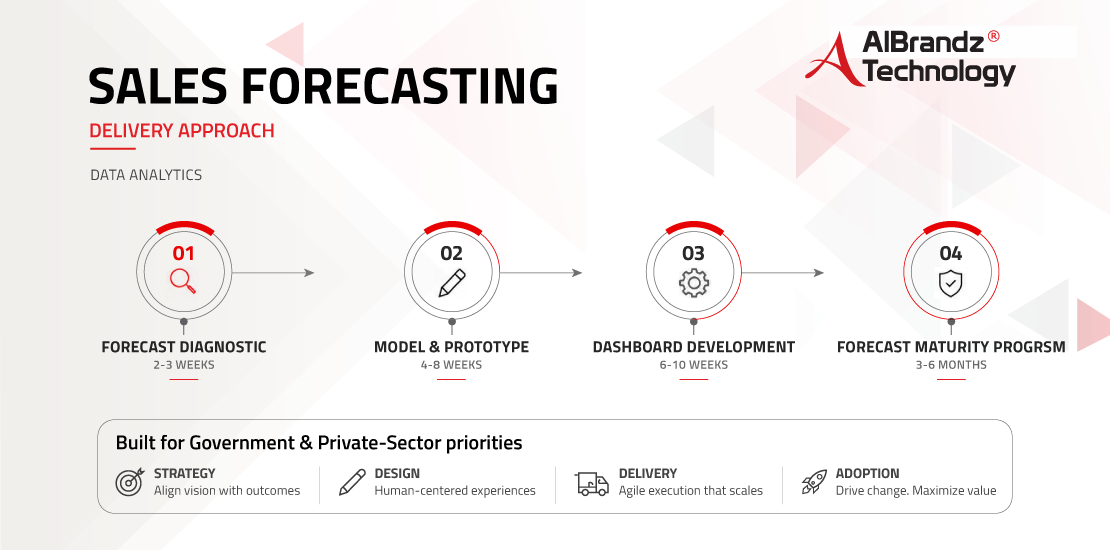
Forecast diagnostic
Current-process review, data profiling, hierarchy design and baseline accuracy assessment. The stage includes stakeholder review, documented decisions and confirmation of the inputs required for the next phase.
Model and prototype
Driver analysis, model comparison, scenario design and stakeholder validation. The stage includes stakeholder review, documented decisions and confirmation of the inputs required for the next phase.
Dashboard deployment
Automated inputs, reporting, access, variance analysis, testing and training. The stage includes stakeholder review, documented decisions and confirmation of the inputs required for the next phase.
Forecast maturity programme
Multiple business units, governance, overrides, accuracy tracking and continuous improvement. The stage includes stakeholder review, documented decisions and confirmation of the inputs required for the next phase.
Discuss your sales forecasting requirements with Albrandz Technology and request a tailored GCC delivery plan.
Benefits of Sales Forecasting
- Retailers and distributors managing seasonal, promotional or multi-location demand.
- B2B organisations with opportunity pipelines, tenders, contracts or project-based revenue.
- E-commerce businesses planning inventory, fulfilment, marketing and customer-service capacity.
- Finance and commercial leaders requiring dependable revenue scenarios and forecast accountability.
- Public-sector entities requiring reliable KPIs, management reporting and evidence-based planning.
- Private enterprises seeking stronger commercial, financial or operational decision support.
Who Needs Sales Forecasting?
- Leadership teams considering AI but lacking agreed priorities, governance or investment criteria.
- Entities with several AI pilots that need consolidation into an enterprise programme.
- PMOs and transformation offices responsible for coordinating cross-functional digital initiatives.
- Regulated organisations requiring responsible AI controls before production deployment.
- Government and semi-government organisations adopting AI within governed service or operational environments.
- Private enterprises that need a practical business case and controlled path to production.
How Much Time Is Needed for Sales Forecasting?
Delivery time depends on scope, data and system readiness, stakeholder availability, procurement requirements, security reviews, integrations and approval cycles. Indicative delivery ranges are:
- Forecast diagnostic (2-3 weeks): Delivery range subject to confirmed scope, inputs, approvals and resource availability.
- Model and prototype (4-8 weeks): Delivery range subject to confirmed scope, inputs, approvals and resource availability.
- Dashboard deployment (6-10 weeks): Delivery range subject to confirmed scope, inputs, approvals and resource availability.
- Forecast maturity programme (3-6 months): Delivery range subject to confirmed scope, inputs, approvals and resource availability.
The final schedule is confirmed after discovery and scope validation. Government programmes may require additional time for tender procedures, governance approvals, security assessment, data classification, hosting decisions and formal acceptance.
Sales Forecasting
Click below to learn more about our services and solutions.