

PMIS Implementation
PMIS Implementation
Implement an integrated Project Management Information System for workflows, controls, documents and portfolio reporting.
PMIS Implementation replaces fragmented spreadsheets, emails and disconnected tools with a controlled environment for project information and decisions. The service begins with business processes and reporting needs, then determines whether configuration, custom development or a hybrid solution is appropriate. Scope may cover portfolio, schedule, cost, risk, change, contracts, documents, workflows and executive dashboards.
Government and infrastructure programmes may require vendor hosting during development, migration to client infrastructure, data classification, integrations with ERP or document platforms, formal releases and detailed acceptance. Albrandz Technology structures these dependencies within the requirements, architecture, release and transition plans. Albrandz Technology structures the engagement for organisations operating across Saudi Arabia, the UAE, Qatar, Oman, Bahrain and Kuwait, with clear scope, stakeholder responsibilities, review points, acceptance criteria and knowledge transfer.
What PMIS Implementation Includes
PMIS Strategy and Requirements
Solution and Architecture
Configuration or Development
Integration and Migration
Testing and Rollout
GCC Delivery Considerations for PMIS Implementation
PMO and project-controls delivery in the GCC commonly involves clients, authorities, operating companies, consultants, contractors and technology vendors. The service must fit the organisation’s delegated authority, procurement model, contract environment and portfolio maturity. Government programmes may require formal stage gates, audit evidence and standard reporting across entities; private developers may prioritise speed, commercial control and decision clarity. Effective implementation includes governance, process, systems, data, people and adoption rather than relying on templates or software alone.
Our PMIS Implementation Delivery Approach
The engagement is managed through clear stages and review gates. The exact activities are tailored to the confirmed scope, but a typical PMIS Implementation assignment follows the approach below:
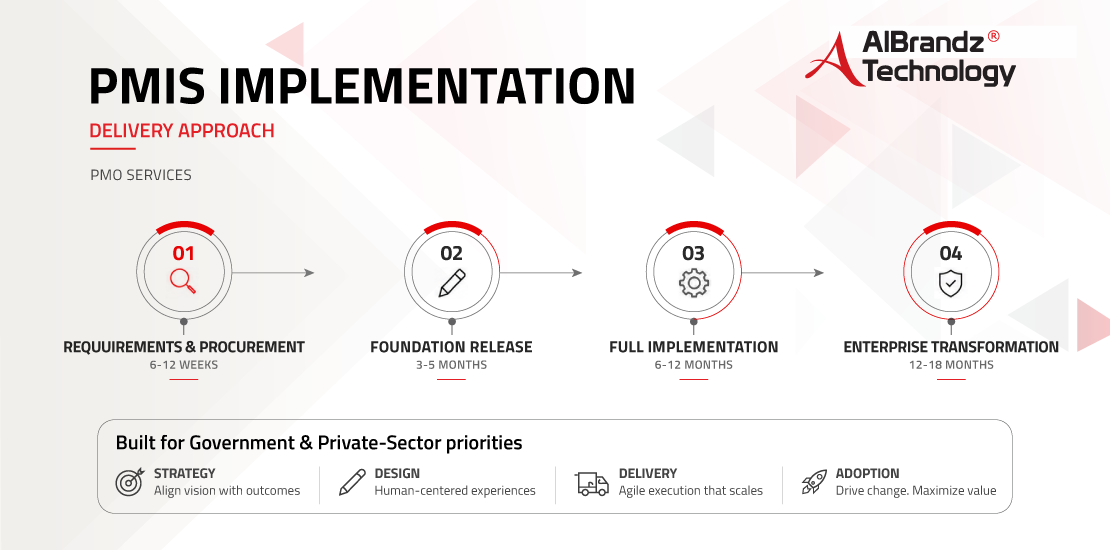
Requirements and procurement
Workshops, process design, requirements, architecture, release plan and tender support where needed. The stage includes stakeholder review, documented decisions and confirmation of the inputs required for the next phase.
Foundation release
Core setup, users, projects, workflows, documents, dashboards and initial integrations. The stage includes stakeholder review, documented decisions and confirmation of the inputs required for the next phase.
Full implementation
Multiple modules, integrations, migration, testing, training and phased rollout. The stage includes stakeholder review, documented decisions and confirmation of the inputs required for the next phase.
Enterprise transformation
Complex portfolio, several entities, advanced controls, infrastructure migration and broad adoption. The stage includes stakeholder review, documented decisions and confirmation of the inputs required for the next phase.
Discuss your pmis implementation requirements with Albrandz Technology and request a tailored GCC delivery plan.
Benefits of PMIS Implementation
- Creates one controlled source for project workflows, information, records and reporting.
- Reduces manual consolidation and improves the timeliness of portfolio dashboards.
- Strengthens auditability through approvals, timestamps, roles, baselines and change history.
- Enables phased module releases so users receive value before the full programme is complete.
- Improves management visibility through documented standards, ownership and reliable reporting cycles.
- Supports governance, auditability and timely escalation across complex stakeholder environments.
Who Needs PMIS Implementation?
- Government delivery authorities and semi-government infrastructure organisations.
- Airports, transport, utilities and capital-project owners coordinating many stakeholders.
- Real-estate developers, construction companies and engineering consultants.
- PMOs replacing legacy tools or needing integration across schedule, finance and documents.
- Government delivery entities and infrastructure owners managing programmes, consultants and contractors.
- Private developers and enterprises that need stronger project governance and performance control.
How Much Time Is Needed for PMIS Implementation?
Delivery time depends on scope, data and system readiness, stakeholder availability, procurement requirements, security reviews, integrations and approval cycles. Indicative delivery ranges are:
- Requirements and procurement (6-12 weeks): Delivery range subject to confirmed scope, inputs, approvals and resource availability.
- Foundation release (3-5 months): Delivery range subject to confirmed scope, inputs, approvals and resource availability.
- Full implementation (6-12 months): Delivery range subject to confirmed scope, inputs, approvals and resource availability.
- Enterprise transformation (12-18 months): Delivery range subject to confirmed scope, inputs, approvals and resource availability.
The final schedule is confirmed after discovery and scope validation. Government programmes may require additional time for tender procedures, governance approvals, security assessment, data classification, hosting decisions and formal acceptance.
PMIS Implementation
Click below to learn more about our services and solutions.