

Workflow Automation
Workflow Automation
Digitise forms, approvals, notifications and service processes with transparent, auditable workflows.
Workflow Automation replaces email chains, paper forms and disconnected spreadsheets with a structured digital process. The service maps the current workflow, removes unnecessary steps and configures forms, business rules, approvals, alerts, escalations, queues and audit records. Managers receive visibility into workload, turnaround, bottlenecks and service-level performance.
Government and regulated workflows often include delegated authority, segregation of duties, retention and formal evidence requirements. Albrandz Technology documents these controls and designs exception handling so automation increases efficiency without weakening accountability. Albrandz Technology structures the engagement for organisations operating across Saudi Arabia, the UAE, Qatar, Oman, Bahrain and Kuwait, with clear scope, stakeholder responsibilities, review points, acceptance criteria and knowledge transfer.
What Workflow Automation Includes
Process Discovery
Forms and Business Rules
Approvals and Service Levels
Integration and Records
Monitoring and Improvement
GCC Delivery Considerations for Workflow Automation
Digital applications for GCC users may require Arabic and English interfaces, accessibility, mobile-first design, approved identity services, data classification, secure hosting and integration with existing platforms. Government delivery can include architecture review, security assessment, formal user acceptance and staged production approval. Private-sector delivery may prioritise speed to market, customer conversion and operational efficiency. Albrandz Technology uses release-based planning so that essential functions, dependencies and acceptance criteria remain visible throughout design, build, testing and transition.
Our Workflow Automation Delivery Approach
The engagement is managed through clear stages and review gates. The exact activities are tailored to the confirmed scope, but a typical Workflow Automation assignment follows the approach below:
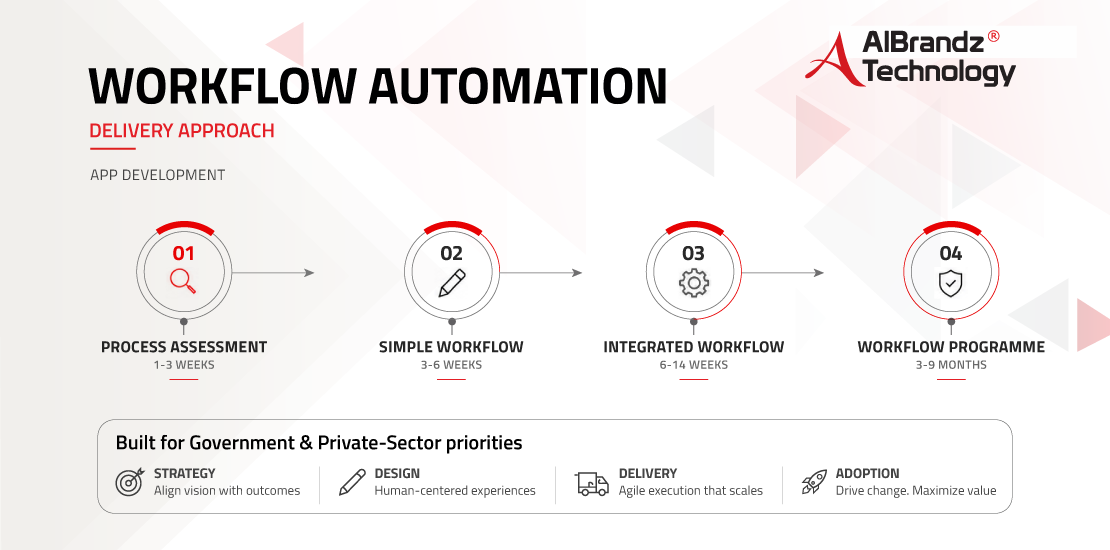
Process assessment
Current-state mapping, controls, requirements, future-state design and automation backlog. The stage includes stakeholder review, documented decisions and confirmation of the inputs required for the next phase.
Simple workflow
Form, routing, notifications, dashboard, testing and release. The stage includes stakeholder review, documented decisions and confirmation of the inputs required for the next phase.
Integrated workflow
Complex rules, roles, APIs, document records, security and user acceptance. The stage includes stakeholder review, documented decisions and confirmation of the inputs required for the next phase.
Workflow programme
Multiple processes, shared components, governance, adoption and benefit tracking. The stage includes stakeholder review, documented decisions and confirmation of the inputs required for the next phase.
Discuss your bi dashboards requirements with Albrandz Technology and request a tailored GCC delivery plan.
Benefits of Workflow Automation
- Reduces process cycle time, manual follow-up and avoidable administrative effort.
- Improves transparency by showing status, ownership, pending action and escalation in real time.
- Strengthens control through validation, delegated authority, audit trails and consistent routing.
- Creates operational data for workload planning, service improvement and management reporting.
- Supports phased releases, documented testing and maintainable handover for future enhancement.
- Connects digital user journeys with existing business rules, data and enterprise systems.
Who Needs Workflow Automation?
- Government entities digitising applications, permits, internal requests or approval services.
- HR, finance, procurement and administration teams managing repeatable approvals and records.
- Project organisations handling submittals, changes, correspondence, payments or technical reviews.
- Enterprises relying on email and spreadsheets to coordinate high-volume service processes.
- Government entities digitising citizen, business, employee or field-service processes.
- Private organisations requiring secure custom applications that fit their operating model.
How Much Time Is Needed for Workflow Automation?
Delivery time depends on scope, data and system readiness, stakeholder availability, procurement requirements, security reviews, integrations and approval cycles. Indicative delivery ranges are:
- Process assessment (1-3 weeks): Delivery range subject to confirmed scope, inputs, approvals and resource availability.
- Simple workflow (3-6 weeks): Delivery range subject to confirmed scope, inputs, approvals and resource availability.
- Integrated workflow (6-14 weeks): Delivery range subject to confirmed scope, inputs, approvals and resource availability.
- Workflow programme (3-9 months): Delivery range subject to confirmed scope, inputs, approvals and resource availability.
The final schedule is confirmed after discovery and scope validation. Government programmes may require additional time for tender procedures, governance approvals, security assessment, data classification, hosting decisions and formal acceptance.
Workflow Automation
Click below to learn more about our services and solutions.