

Predictive Analytics
Predictive Analytics
Use historical and current data to estimate future demand, risk, performance and operational outcomes.
Predictive Analytics applies statistical and machine-learning methods to estimate what is likely to happen and how confident the organisation should be in that estimate. The service is suitable when sufficient historical data exists and a clear decision can be improved by forecasting, classification or risk scoring. Models are evaluated against simple baselines and business costs, not technical accuracy alone.
In regulated, government or high-impact environments, predictions require transparent assumptions, controlled data access, human review and monitoring for changing conditions. Albrandz Technology documents the model purpose, limitations, validation, thresholds and operational response so users understand how to apply the output responsibly. Albrandz Technology structures the engagement for organisations operating across Saudi Arabia, the UAE, Qatar, Oman, Bahrain and Kuwait, with clear scope, stakeholder responsibilities, review points, acceptance criteria and knowledge transfer.
What Predictive Analytics Includes
Decision and Use-Case Design
Data Preparation
Model Development
Business Validation
Deployment and Monitoring
GCC Delivery Considerations for Predictive Analytics
Analytics delivery in the GCC often spans several systems, departments, projects or operating companies. Before publishing results, organisations need agreed KPI definitions, reconciliation with approved sources, access controls and named data owners. Government reporting may require formal review and traceability, while commercial teams may prioritise speed, forecasting and decision support. In both cases, the solution should preserve a clear link between source data, calculation, visual output and management action. Training and refresh ownership are essential if the analytics is to remain trusted after launch.
Our Predictive Analytics Delivery Approach
The engagement is managed through clear stages and review gates. The exact activities are tailored to the confirmed scope, but a typical Predictive Analytics assignment follows the approach below:
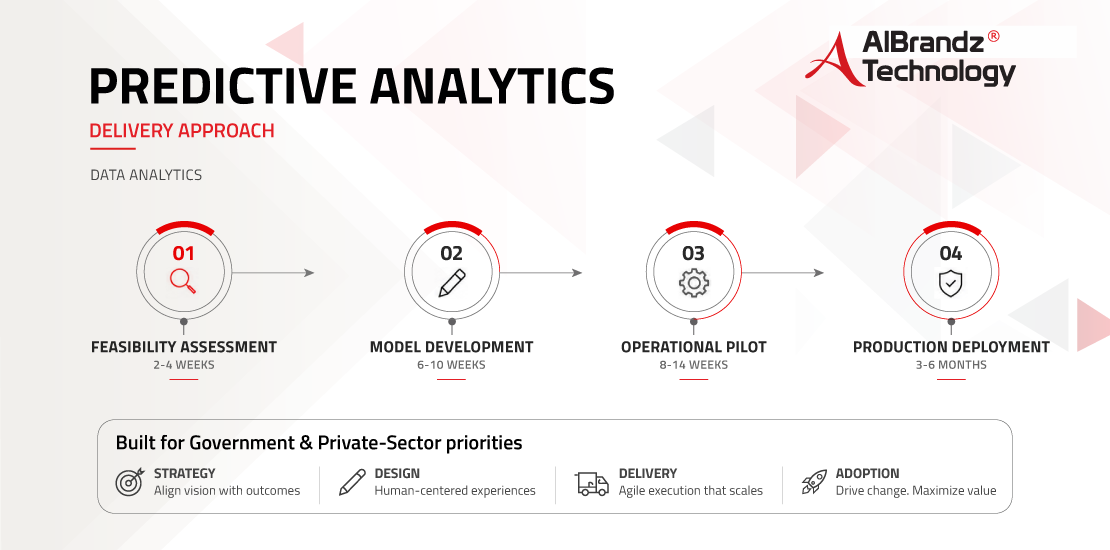
Feasibility assessment
Decision design, data profiling, baseline analysis and recommendation on model viability. The stage includes stakeholder review, documented decisions and confirmation of the inputs required for the next phase.
Model development
Data preparation, feature development, model comparison, validation and business review. The stage includes stakeholder review, documented decisions and confirmation of the inputs required for the next phase.
Operational pilot
Dashboard or workflow integration, user testing, threshold calibration and benefit measurement. The stage includes stakeholder review, documented decisions and confirmation of the inputs required for the next phase.
Production deployment
Robust pipelines, monitoring, security, documentation, training and operating ownership. The stage includes stakeholder review, documented decisions and confirmation of the inputs required for the next phase.
Discuss your predictive analytics requirements with Albrandz Technology and request a tailored GCC delivery plan.
Benefits of Predictive Analytics
- Supports earlier action by identifying likely demand, delays, risks or customer behaviour.
- Improves planning by replacing single-point assumptions with evidence-based estimates and ranges.
- Prioritises cases, assets or customers so limited resources can focus on the highest expected impact.
- Creates a repeatable analytical process that can be monitored and improved over time.
- Creates governed definitions and validation rules so decision-makers can trust the resulting insight.
- Reduces recurring manual reporting and supports faster performance review across locations or functions.
Who Needs Predictive Analytics?
- Planning teams forecasting service demand, workload, capacity or resource requirements.
- Project organisations estimating delay, cost-overrun, safety or delivery risk.
- Commercial teams predicting sales, churn, conversion, collections or customer value.
- Asset-intensive organisations anticipating maintenance, failure or operational exceptions.
- Public-sector entities requiring reliable KPIs, management reporting and evidence-based planning.
- Private enterprises seeking stronger commercial, financial or operational decision support.
How Much Time Is Needed for Predictive Analytics?
Delivery time depends on scope, data and system readiness, stakeholder availability, procurement requirements, security reviews, integrations and approval cycles. Indicative delivery ranges are:
- Feasibility assessment (2-4 weeks): Delivery range subject to confirmed scope, inputs, approvals and resource availability.
- Model development (6-10 weeks): Delivery range subject to confirmed scope, inputs, approvals and resource availability.
- Operational pilot (8-14 weeks): Delivery range subject to confirmed scope, inputs, approvals and resource availability.
- Production deployment (3-6 months): Delivery range subject to confirmed scope, inputs, approvals and resource availability.
The final schedule is confirmed after discovery and scope validation. Government programmes may require additional time for tender procedures, governance approvals, security assessment, data classification, hosting decisions and formal acceptance.
Predictive Analytics
Click below to learn more about our services and solutions.