
AI Strategy
AI Strategy
Create a practical AI strategy that links investment, governance and implementation to measurable organisational priorities.
AI Strategy consulting gives leadership a fact-based route from ambition to execution. The service evaluates business priorities, processes, data, technology, people and governance before recommending where AI should be applied, what capabilities are required and how benefits will be measured. It is designed to prevent fragmented pilots, unclear ownership and technology investment without an approved operating model.
Public-sector AI strategies may require formal governance, data classification, procurement planning, transparency and human oversight, while private-sector strategies may prioritise productivity, customer experience, growth or cost reduction. The roadmap is adapted to the organisation’s mandate, risk profile and investment capacity. Albrandz Technology structures the engagement for organisations operating across Saudi Arabia, the UAE, Qatar, Oman, Bahrain and Kuwait, with clear scope, stakeholder responsibilities, review points, acceptance criteria and knowledge transfer.
What AI Strategy Includes
AI Readiness Assessment
Use-Case Discovery
Use-Case Prioritisation
Governance and Operating Model
Roadmap and Business Case
GCC Delivery Considerations for AI Strategy
AI delivery in GCC organisations should balance innovation with data governance, cybersecurity, human oversight and operational accountability. Public-sector entities may need formal use-case approval, procurement documentation, hosting decisions and evidence that the solution supports policy and service objectives. Private enterprises may move faster, but still need controlled access, reliable data, measurable benefits and a clear owner for ongoing performance. Where Arabic and English experiences are required, language quality and source coverage should be tested as part of acceptance rather than assumed from the underlying technology.
Our AI Strategy Delivery Approach
The engagement is managed through clear stages and review gates. The exact activities are tailored to the confirmed scope, but a typical AI Strategy assignment follows the approach below:
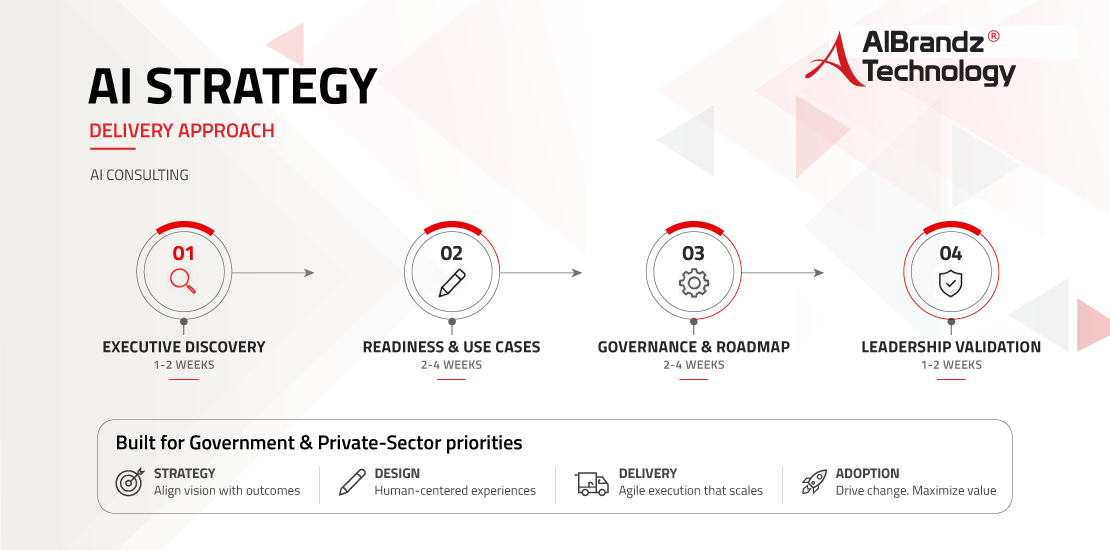
Executive discovery
Leadership interviews, strategic-priority review and confirmation of assessment scope and decision criteria. The stage includes stakeholder review, documented decisions and confirmation of the inputs required for the next phase.
Readiness and use cases
Workshops, process and data review, opportunity definition, feasibility assessment and prioritisation. The stage includes stakeholder review, documented decisions and confirmation of the inputs required for the next phase.
Governance and roadmap
Operating model, implementation waves, resources, benefits, risks, KPIs and investment sequence. The stage includes stakeholder review, documented decisions and confirmation of the inputs required for the next phase.
Leadership validation
Review, refinement, decision workshop and issue of the approved strategy package. The stage includes stakeholder review, documented decisions and confirmation of the inputs required for the next phase.
Discuss your ai strategy requirements with Albrandz Technology and request a tailored GCC delivery plan.
Benefits of AI Strategy
- Aligns executives, business functions and IT around one prioritised AI agenda.
- Directs investment towards feasible use cases with defined owners and measurable benefits.
- Identifies data, integration, security and capability gaps before delivery begins.
- Creates a defensible roadmap for budgeting, procurement and leadership approval.
- Uses phased validation and measurable acceptance criteria before organisation-wide scaling.
- Supports responsible adoption through documented data, access, approval and monitoring controls.
Who Needs AI Strategy?
- Leadership teams considering AI but lacking agreed priorities, governance or investment criteria.
- Entities with several AI pilots that need consolidation into an enterprise programme.
- PMOs and transformation offices responsible for coordinating cross-functional digital initiatives.
- Regulated organisations requiring responsible AI controls before production deployment.
- Government and semi-government organisations adopting AI within governed service or operational environments.
- Private enterprises that need a practical business case and controlled path to production.
How Much Time Is Needed for AI Strategy?
Delivery time depends on scope, data and system readiness, stakeholder availability, procurement requirements, security reviews, integrations and approval cycles. Indicative delivery ranges are:
- Executive discovery (1–2 weeks):
Delivery range subject to confirmed scope, inputs, approvals and resource availability. - Readiness and use cases (2–4 weeks):
Delivery range subject to confirmed scope, inputs, approvals and resource availability. - Governance and roadmap (2–4 weeks):
Delivery range subject to confirmed scope, inputs, approvals and resource availability. - Leadership validation (1–2 weeks):
Delivery range subject to confirmed scope, inputs, approvals and resource availability.
The final schedule is confirmed after discovery and scope validation. Government programmes may require additional time for tender procedures, governance approvals, security assessment, data classification, hosting decisions and formal acceptance.