
AI Automation
AI Automation
Automate document-heavy and repetitive business processes using AI, workflow and system integration.
AI Automation applies capabilities such as document classification, information extraction, language understanding and decision support within controlled workflows. It is most effective where staff repeatedly read, copy, categorise, validate or route information. Our service redesigns the end-to-end process, introduces AI only where appropriate and retains human review for exceptions or high-impact decisions.
Government and enterprise processes often cross several departments and contain formal approval, retention and evidence requirements. Automation is therefore designed around existing policy, delegated authority, service-level targets, integration constraints and business-continuity needs rather than treating the AI model as a standalone tool. Albrandz Technology structures the engagement for organisations operating across Saudi Arabia, the UAE, Qatar, Oman, Bahrain and Kuwait, with clear scope, stakeholder responsibilities, review points, acceptance criteria and knowledge transfer.
What AI Automation Includes
Process Assessment
Document and Data Intelligence
Workflow Orchestration
Enterprise Integration
Monitoring and Optimisation
GCC Delivery Considerations for AI Automation
AI delivery in GCC organisations should balance innovation with data governance, cybersecurity, human oversight and operational accountability. Public-sector entities may need formal use-case approval, procurement documentation, hosting decisions and evidence that the solution supports policy and service objectives. Private enterprises may move faster, but still need controlled access, reliable data, measurable benefits and a clear owner for ongoing performance. Where Arabic and English experiences are required, language quality and source coverage should be tested as part of acceptance rather than assumed from the underlying technology.
Our AI Automation Delivery Approach
The engagement is managed through clear stages and review gates. The exact activities are tailored to the confirmed scope, but a typical AI Automation assignment follows the approach below:
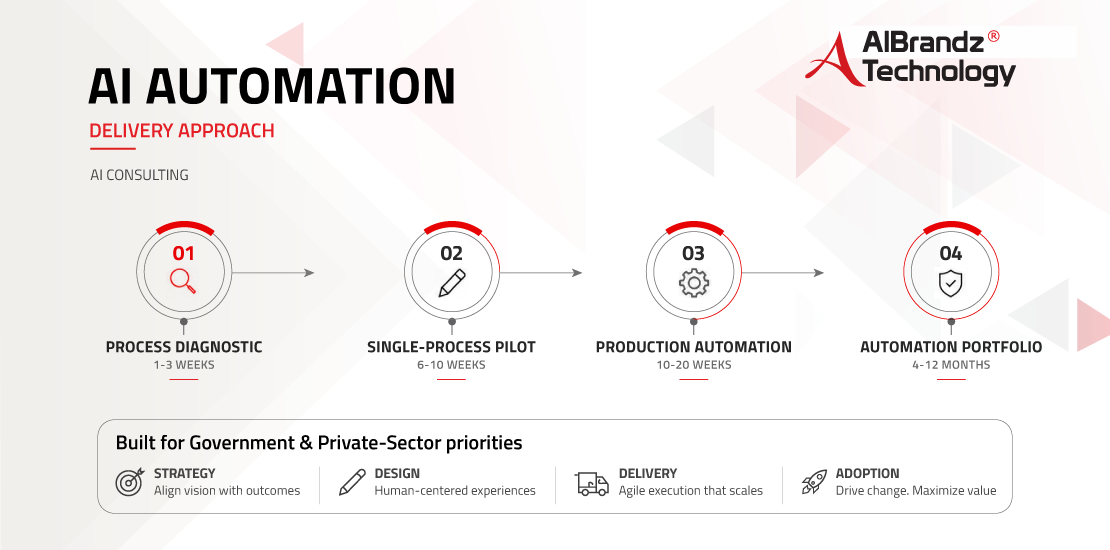
Process diagnostic
Process mapping, volume and control analysis, automation scoring and target-state recommendation. The stage includes stakeholder review, documented decisions and confirmation of the inputs required for the next phase.
Single-process pilot
Document or language model, workflow, limited integration, testing and benefit validation. The stage includes stakeholder review, documented decisions and confirmation of the inputs required for the next phase.
Production automation
Robust integrations, exception handling, security, monitoring, training and controlled deployment. The stage includes stakeholder review, documented decisions and confirmation of the inputs required for the next phase.
Automation portfolio
Multiple processes, reusable components, governance, benefit tracking and scaled adoption. The stage includes stakeholder review, documented decisions and confirmation of the inputs required for the next phase.
Discuss your ai automation requirements with Albrandz Technology and request a tailored GCC delivery plan.
Benefits of AI Automation
- Shortens cycle time for high-volume requests, documents, approvals and service transactions.
- Reduces rekeying, inconsistency and preventable manual processing errors.
- Maintains human oversight for exceptions, sensitive cases and approval decisions.
- Provides real-time workload, bottleneck and service-level visibility to managers.
- Uses phased validation and measurable acceptance criteria before organisation-wide scaling.
- Supports responsible adoption through documented data, access, approval and monitoring controls.
Who Needs AI Automation?
- Finance and procurement teams processing invoices, purchase requests, vendor documents or approvals.
- HR and shared-service teams managing onboarding, employee requests and document validation.
- Project organisations handling correspondence, submittals, reports and commercial records.
- Customer operations processing applications, claims, service requests or case documents.
- Government and semi-government organisations adopting AI within governed service or operational environments.
- Private enterprises that need a practical business case and controlled path to production.
How Much Time Is Needed for AI Automation?
Delivery time depends on scope, data and system readiness, stakeholder availability, procurement requirements, security reviews, integrations and approval cycles. Indicative delivery ranges are:
- Process diagnostic (1-3 weeks): Delivery range subject to confirmed scope, inputs, approvals and resource availability.
- Single-process pilot (6-10 weeks): Delivery range subject to confirmed scope, inputs, approvals and resource availability.
- Production automation (10-20 weeks): Delivery range subject to confirmed scope, inputs, approvals and resource availability.
- Automation portfolio (4-12 months): Delivery range subject to confirmed scope, inputs, approvals and resource availability.
The final schedule is confirmed after discovery and scope validation. Government programmes may require additional time for tender procedures, governance approvals, security assessment, data classification, hosting decisions and formal acceptance.