

Mobile App Development
Mobile App Development
Create reliable iOS and Android applications for customers, citizens, employees and field operations.
Mobile App Development turns selected services and workflows into convenient experiences on smartphones and tablets. The service covers product discovery, interface design, platform selection, development, integration, testing, store release and lifecycle support. Decisions about native or cross-platform development are based on performance, device features, user experience, timeline and maintainability.
GCC mobile users expect fast, intuitive and trustworthy experiences. Depending on scope, applications may require Arabic and English interfaces, digital identity, payments, notifications, offline use, location services, document capture and strong privacy controls. Operational ownership for content, support, analytics and updates is defined before launch. Albrandz Technology structures the engagement for organisations operating across Saudi Arabia, the UAE, Qatar, Oman, Bahrain and Kuwait, with clear scope, stakeholder responsibilities, review points, acceptance criteria and knowledge transfer.
What Mobile App Development Includes
Mobile Product Strategy
Mobile UX Design
Application Development
Backend and Integration
Quality and Release
GCC Delivery Considerations for Mobile App Development
Digital applications for GCC users may require Arabic and English interfaces, accessibility, mobile-first design, approved identity services, data classification, secure hosting and integration with existing platforms. Government delivery can include architecture review, security assessment, formal user acceptance and staged production approval. Private-sector delivery may prioritise speed to market, customer conversion and operational efficiency. Albrandz Technology uses release-based planning so that essential functions, dependencies and acceptance criteria remain visible throughout design, build, testing and transition.
Our Mobile App Development Delivery Approach
The engagement is managed through clear stages and review gates. The exact activities are tailored to the confirmed scope, but a typical Mobile App Development assignment follows the approach below:
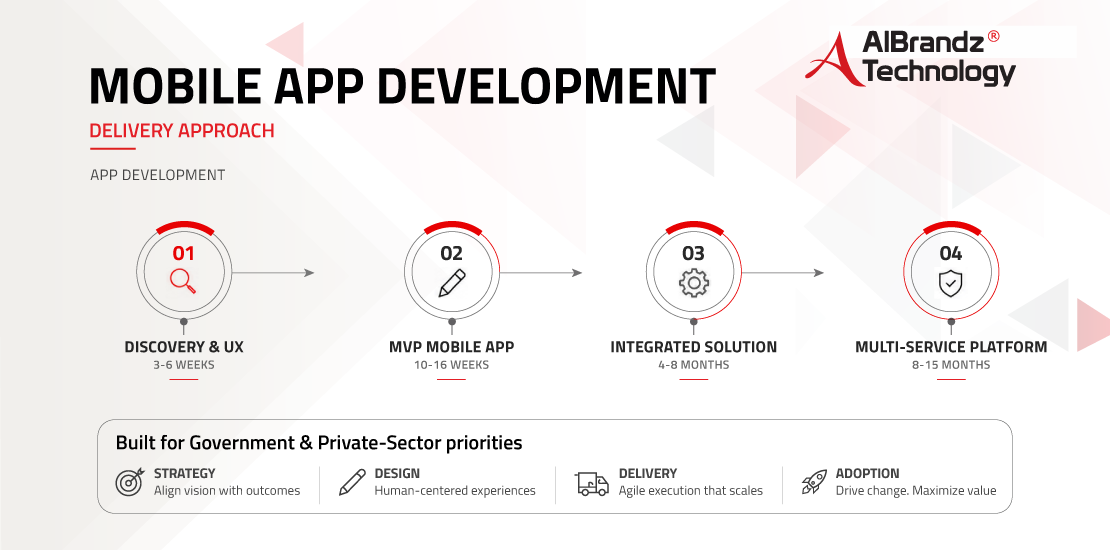
Discovery and UX
User research, journeys, prototype, platform decision, integrations and release plan. The stage includes stakeholder review, documented decisions and confirmation of the inputs required for the next phase.
MVP mobile app
Core application, backend integration, testing and initial store release. The stage includes stakeholder review, documented decisions and confirmation of the inputs required for the next phase.
Integrated mobile solution
Transactions, offline features, payments, GIS, security and phased deployment. The stage includes stakeholder review, documented decisions and confirmation of the inputs required for the next phase.
Multi-service platform
Several modules, complex integrations, scale testing, adoption and ongoing releases. The stage includes stakeholder review, documented decisions and confirmation of the inputs required for the next phase.
Discuss your mobile app development requirements with Albrandz Technology and request a tailored GCC delivery plan.
Benefits of Mobile App Development
- Provides convenient access to services for mobile-first users and field-based employees.
- Uses device capabilities such as camera, location, biometrics, notifications and offline storage.
- Improves engagement through streamlined journeys and timely, permission-based communication.
- Extends enterprise systems through controlled APIs without exposing internal platforms directly.
- Supports phased releases, documented testing and maintainable handover for future enhancement.
- Connects digital user journeys with existing business rules, data and enterprise systems.
Who Needs Mobile App Development?
- Government and municipal entities extending public services to mobile channels.
- Field-service, construction, logistics and facilities teams capturing information away from offices.
- Retail, hospitality, healthcare and financial-service organisations improving customer engagement.
- Enterprises requiring secure employee self-service, approvals or operational notifications.
- Government entities digitising citizen, business, employee or field-service processes.
- Private organisations requiring secure custom applications that fit their operating model.
How Much Time Is Needed for Mobile App Development?
Delivery time depends on scope, data and system readiness, stakeholder availability, procurement requirements, security reviews, integrations and approval cycles. Indicative delivery ranges are:
- Discovery and UX (3-6 weeks): Delivery range subject to confirmed scope, inputs, approvals and resource availability.
- MVP mobile app (10-16 weeks): Delivery range subject to confirmed scope, inputs, approvals and resource availability.
- Integrated mobile solution (4-8 months): Delivery range subject to confirmed scope, inputs, approvals and resource availability.
- Multi-service platform (8-15 months): Delivery range subject to confirmed scope, inputs, approvals and resource availability.
The final schedule is confirmed after discovery and scope validation. Government programmes may require additional time for tender procedures, governance approvals, security assessment, data classification, hosting decisions and formal acceptance.
Mobile App Development
Click below to learn more about our services and solutions.