

Cloud Security
Cloud Security
Secure cloud adoption through strong identity, configuration, data, monitoring and shared-responsibility controls.
Cloud Security addresses the risks created when applications and information move beyond traditional data-centre boundaries. The service covers governance, architecture, identity, network segmentation, workload protection, encryption, logging, backup, vulnerability management and incident readiness. Responsibilities between the client, cloud provider and implementation partners are made explicit.
GCC cloud programmes may be influenced by data classification, residency, sector rules, government controls and approved-provider requirements. The solution is aligned with the specific jurisdiction, organisation and cloud service model rather than assuming every workload can use the same architecture. Albrandz Technology structures the engagement for organisations operating across Saudi Arabia, the UAE, Qatar, Oman, Bahrain and Kuwait, with clear scope, stakeholder responsibilities, review points, acceptance criteria and knowledge transfer.
What Cloud Security Includes
Cloud Security Assessment
Secure Cloud Architecture
Workload Protection
Monitoring and Response
Cloud Governance
GCC Delivery Considerations for Cloud Security
Cybersecurity requirements differ across GCC jurisdictions, sectors, entity types and system classifications. The applicable baseline must therefore be confirmed for each engagement, including client policies, national controls, contracts, cloud requirements and legal guidance. Government and critical-infrastructure work may require stricter evidence, testing windows, data handling and approval. Albrandz Technology supports assessment, remediation and readiness but does not represent its work as legal advice, regulator certification or a guarantee of compliance acceptance.
Our Cloud Security Delivery Approach
The engagement is managed through clear stages and review gates. The exact activities are tailored to the confirmed scope, but a typical Cloud Security assignment follows the approach below:
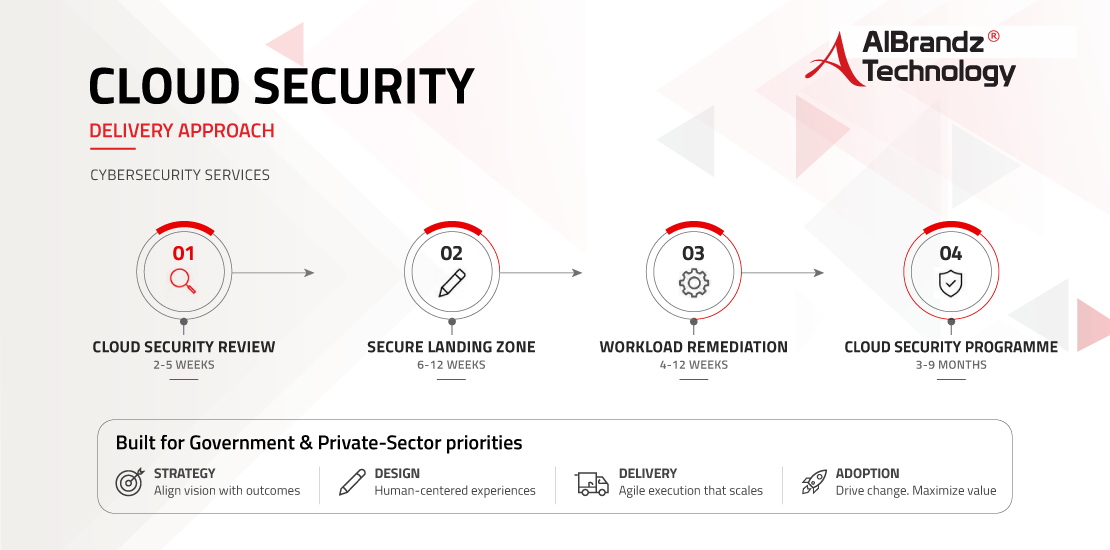
Cloud security review
Architecture, configuration, identity, data, logging and governance assessment. The stage includes stakeholder review, documented decisions and confirmation of the inputs required for the next phase.
Secure landing zone
Identity, network, policies, logging, keys, accounts and deployment guardrails. The stage includes stakeholder review, documented decisions and confirmation of the inputs required for the next phase.
Workload remediation
Priority configuration, access, monitoring, backup and vulnerability improvements. The stage includes stakeholder review, documented decisions and confirmation of the inputs required for the next phase.
Cloud security programme
Multiple workloads, governance, automation, monitoring and operating-model adoption. The stage includes stakeholder review, documented decisions and confirmation of the inputs required for the next phase.
Discuss your cloud security requirements with Albrandz Technology and request a tailored GCC delivery plan.
Benefits of Cloud Security
- Reduces misconfiguration, excessive access and unmonitored exposure in cloud environments.
- Clarifies security responsibilities between client teams, providers and delivery partners.
- Supports compliant workload placement through data classification and architecture decisions.
- Improves visibility and response through centralised cloud logging and security monitoring.
- Produces risk-ranked findings and an actionable remediation plan rather than an undifferentiated issue list.
- Supports security and compliance readiness without claiming regulator approval or certification.
Who Needs Cloud Security?
- Government and regulated organisations planning or operating cloud-hosted services.
- Enterprises migrating applications, analytics, AI or collaboration platforms to cloud environments.
- Technology teams building cloud landing zones, DevSecOps pipelines or multi-cloud governance.
- Organisations that have grown cloud use without consistent identity, logging or configuration controls.
- Government, critical-infrastructure and regulated entities with formal control and evidence obligations.
- Private organisations protecting digital services, cloud environments, transactions and sensitive information.
How Much Time Is Needed for Cloud Security?
Delivery time depends on scope, data and system readiness, stakeholder availability, procurement requirements, security reviews, integrations and approval cycles. Indicative delivery ranges are:
- Cloud security review (2-5 weeks): Delivery range subject to confirmed scope, inputs, approvals and resource availability.
- Secure landing zone (6-12 weeks): Delivery range subject to confirmed scope, inputs, approvals and resource availability.
- Workload remediation (4-12 weeks): Delivery range subject to confirmed scope, inputs, approvals and resource availability.
- Cloud security programme (3-9 months): Delivery range subject to confirmed scope, inputs, approvals and resource availability.
The final schedule is confirmed after discovery and scope validation. Government programmes may require additional time for tender procedures, governance approvals, security assessment, data classification, hosting decisions and formal acceptance.
Cloud Security
Click below to learn more about our services and solutions.