

Penetration Testing
Penetration Testing
Identify exploitable weaknesses in applications, APIs, networks and cloud environments through controlled security testing.
Penetration Testing evaluates whether an attacker could exploit weaknesses within an agreed target and rules of engagement. Unlike automated scanning alone, controlled manual testing validates attack paths, business logic and practical impact. The deliverable separates confirmed vulnerabilities from observations and gives technical teams clear reproduction and remediation information.
Testing is authorised in writing, limited to approved systems and coordinated to protect business operations. Government, financial, healthcare and critical-service environments may require additional approvals, test windows, data-handling controls and communication protocols before work begins. Albrandz Technology structures the engagement for organisations operating across Saudi Arabia, the UAE, Qatar, Oman, Bahrain and Kuwait, with clear scope, stakeholder responsibilities, review points, acceptance criteria and knowledge transfer.
What Penetration Testing Includes
Scoping and Rules
Reconnaissance and Testing
Exploitation Validation
Reporting and Briefing
Remediation Retest
GCC Delivery Considerations for Penetration Testing
Cybersecurity requirements differ across GCC jurisdictions, sectors, entity types and system classifications. The applicable baseline must therefore be confirmed for each engagement, including client policies, national controls, contracts, cloud requirements and legal guidance. Government and critical-infrastructure work may require stricter evidence, testing windows, data handling and approval. Albrandz Technology supports assessment, remediation and readiness but does not represent its work as legal advice, regulator certification or a guarantee of compliance acceptance.
Our Penetration Testing Delivery Approach
The engagement is managed through clear stages and review gates. The exact activities are tailored to the confirmed scope, but a typical Penetration Testing assignment follows the approach below:
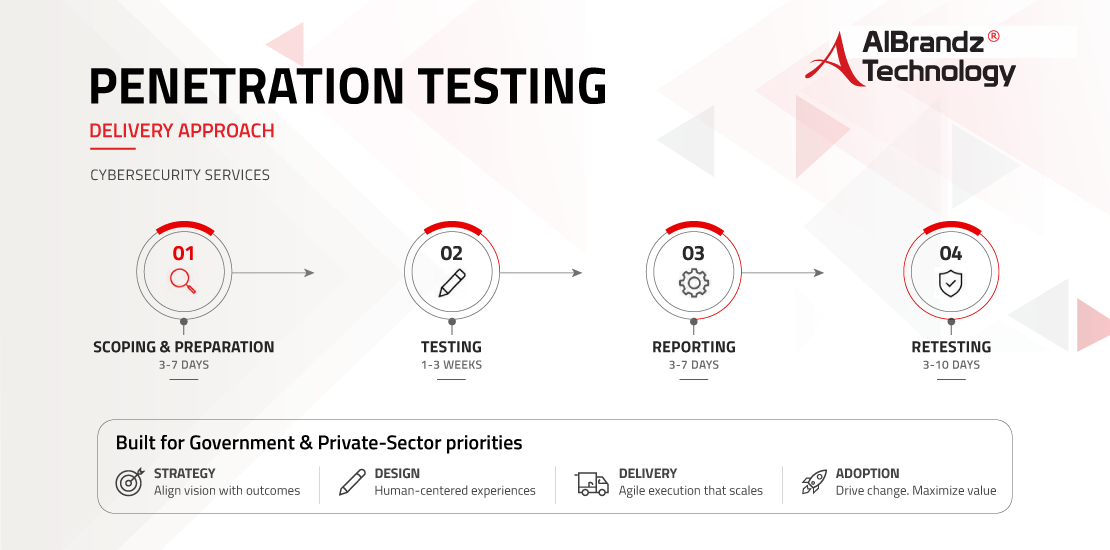
Scoping and preparation
Targets, access, approvals, rules of engagement and communication plan. The stage includes stakeholder review, documented decisions and confirmation of the inputs required for the next phase.
Testing
Controlled application, API, network or cloud testing based on scope and complexity. The stage includes stakeholder review, documented decisions and confirmation of the inputs required for the next phase.
Reporting
Validation, risk rating, evidence, remediation guidance and management briefing. The stage includes stakeholder review, documented decisions and confirmation of the inputs required for the next phase.
Retesting
Verification of remediated findings and final closure status. The stage includes stakeholder review, documented decisions and confirmation of the inputs required for the next phase.
Discuss your bi dashboards requirements with Albrandz Technology and request a tailored GCC delivery plan.
Benefits of Penetration Testing
- Finds exploitable weaknesses before malicious actors or customers encounter them.
- Validates business impact and reduces false positives from automated vulnerability tools.
- Provides developers and infrastructure teams with clear, evidence-based remediation guidance.
- Supports release, audit, tender and supplier-assurance requirements where authorised testing is expected.
- Produces risk-ranked findings and an actionable remediation plan rather than an undifferentiated issue list.
- Supports security and compliance readiness without claiming regulator approval or certification.
Who Needs Penetration Testing?
- Organisations launching or materially changing internet-facing applications and APIs.
- Government, banking, healthcare and critical-service entities requiring periodic security testing.
- Cloud adopters validating configurations, identities and exposed services before production.
- E-commerce and digital-service providers processing accounts, payments or sensitive information.
- Government, critical-infrastructure and regulated entities with formal control and evidence obligations.
- Private organisations protecting digital services, cloud environments, transactions and sensitive information.
How Much Time Is Needed for Penetration Testing?
Delivery time depends on scope, data and system readiness, stakeholder availability, procurement requirements, security reviews, integrations and approval cycles. Indicative delivery ranges are:
- Scoping and preparation (3-7 days): Delivery range subject to confirmed scope, inputs, approvals and resource availability.
- Testing (1-3 weeks): Delivery range subject to confirmed scope, inputs, approvals and resource availability.
- Reporting (3-7 days): Delivery range subject to confirmed scope, inputs, approvals and resource availability.
- Retesting (3-10 days): Delivery range subject to confirmed scope, inputs, approvals and resource availability.
The final schedule is confirmed after discovery and scope validation. Government programmes may require additional time for tender procedures, governance approvals, security assessment, data classification, hosting decisions and formal acceptance.
Penetration Testing
Click below to learn more about our services and solutions.