

Project Planning
Project Planning
Develop realistic, integrated project schedules that support coordination, forecasting and timely corrective action.
Project Planning converts scope and delivery strategy into a time-phased, logic-linked plan. The service covers work breakdown structures, calendars, activities, dependencies, resources, milestones, baselines, progress measurement and reporting. A good schedule is not only a submission document; it must support daily coordination, forecast completion and explain the effect of change.
Complex GCC projects may involve clients, PMCs, designers, contractors, authorities and operating stakeholders. Planning standards define how detailed schedules connect to programme and executive levels, how information is updated and how assumptions, constraints and interfaces are controlled. Albrandz Technology structures the engagement for organisations operating across Saudi Arabia, the UAE, Qatar, Oman, Bahrain and Kuwait, with clear scope, stakeholder responsibilities, review points, acceptance criteria and knowledge transfer.
What Project Planning Includes
Planning Standards
Baseline Schedule
Progress Updating
Schedule Analysis
Recovery and Scenario Planning
GCC Delivery Considerations for Project Planning
PMO and project-controls delivery in the GCC commonly involves clients, authorities, operating companies, consultants, contractors and technology vendors. The service must fit the organisation’s delegated authority, procurement model, contract environment and portfolio maturity. Government programmes may require formal stage gates, audit evidence and standard reporting across entities; private developers may prioritise speed, commercial control and decision clarity. Effective implementation includes governance, process, systems, data, people and adoption rather than relying on templates or software alone.
Our Project Planning Delivery Approach
The engagement is managed through clear stages and review gates. The exact activities are tailored to the confirmed scope, but a typical Project Planning assignment follows the approach below:
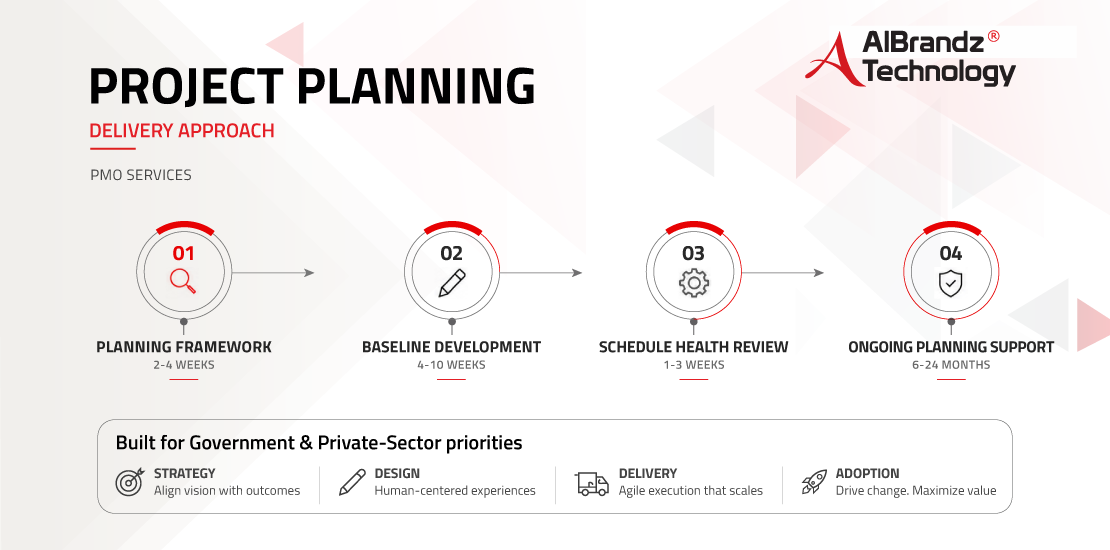
Planning framework
Standards, WBS, coding, reporting calendar, templates and governance. The stage includes stakeholder review, documented decisions and confirmation of the inputs required for the next phase.
Baseline development
Scope review, workshops, schedule build, quality checks and approval support. The stage includes stakeholder review, documented decisions and confirmation of the inputs required for the next phase.
Schedule health review
Logic, constraints, float, critical path, progress and forecast assessment. The stage includes stakeholder review, documented decisions and confirmation of the inputs required for the next phase.
Ongoing planning support
Updates, analysis, reporting, scenarios, assurance and recovery planning. The stage includes stakeholder review, documented decisions and confirmation of the inputs required for the next phase.
Discuss your project planning requirements with Albrandz Technology and request a tailored GCC delivery plan.
Benefits of Project Planning
- Creates a realistic delivery baseline and shared understanding of sequence and responsibilities.
- Identifies critical interfaces, approvals and decisions before they delay execution.
- Provides evidence-based completion forecasts and early warning of schedule pressure.
- Supports recovery planning by testing alternative sequences and mitigation actions.
- Improves management visibility through documented standards, ownership and reliable reporting cycles.
- Supports governance, auditability and timely escalation across complex stakeholder environments.
Who Needs Project Planning?
- Capital projects in aviation, transport, utilities, construction and real estate.
- Government programmes coordinating policy, procurement, technology and operational readiness.
- PMOs consolidating several contractor schedules into programme or portfolio reporting.
- Projects with weak logic, unreliable progress, missed milestones or recovery requirements.
- Government delivery entities and infrastructure owners managing programmes, consultants and contractors.
- Private developers and enterprises that need stronger project governance and performance control.
How Much Time Is Needed for Project Planning?
Delivery time depends on scope, data and system readiness, stakeholder availability, procurement requirements, security reviews, integrations and approval cycles. Indicative delivery ranges are:
- Planning framework (2-4 weeks): Delivery range subject to confirmed scope, inputs, approvals and resource availability.
- Baseline development (4-10 weeks): Delivery range subject to confirmed scope, inputs, approvals and resource availability.
- Schedule health review (1-3 weeks): Delivery range subject to confirmed scope, inputs, approvals and resource availability.
- Ongoing planning support (6-24 months): Delivery range subject to confirmed scope, inputs, approvals and resource availability.
The final schedule is confirmed after discovery and scope validation. Government programmes may require additional time for tender procedures, governance approvals, security assessment, data classification, hosting decisions and formal acceptance.
Project Planning
Click below to learn more about our services and solutions.