Cost Control
Cost Control
Establish reliable budget, commitment, actual, forecast and change controls across projects and portfolios.
Cost Control provides a traceable view from approved budget through commitments, actual expenditure, changes, accruals, forecasts and expected final cost. The service defines structures, responsibilities, data sources, cut-off processes and reporting so management can understand both current position and future exposure. It can be implemented through existing systems, PMIS workflows or controlled reporting tools.
Government and capital projects often include several funding sources, contracts, work packages and approval levels. Cost structures are aligned with finance, procurement, contracts and schedule information so project reporting can be reconciled while still supporting forward-looking management decisions. Albrandz Technology structures the engagement for organisations operating across Saudi Arabia, the UAE, Qatar, Oman, Bahrain and Kuwait, with clear scope, stakeholder responsibilities, review points, acceptance criteria and knowledge transfer.
What Cost Control Includes
Cost Management Framework
Budget and Commitment Control
Actuals and Accruals
Forecasting and EAC
Cost Reporting
GCC Delivery Considerations for Cost Control
PMO and project-controls delivery in the GCC commonly involves clients, authorities, operating companies, consultants, contractors and technology vendors. The service must fit the organisation’s delegated authority, procurement model, contract environment and portfolio maturity. Government programmes may require formal stage gates, audit evidence and standard reporting across entities; private developers may prioritise speed, commercial control and decision clarity. Effective implementation includes governance, process, systems, data, people and adoption rather than relying on templates or software alone.
Our Cost Control Delivery Approach
The engagement is managed through clear stages and review gates. The exact activities are tailored to the confirmed scope, but a typical Cost Control assignment follows the approach below:
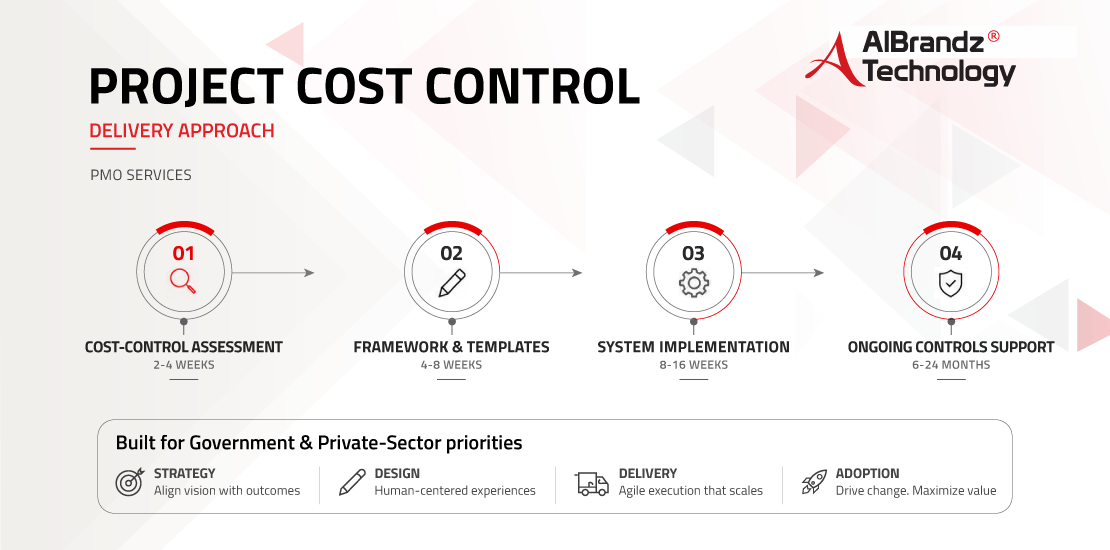
Cost-control assessment
Structures, processes, data, reports, gaps and improvement roadmap. The stage includes stakeholder review, documented decisions and confirmation of the inputs required for the next phase.
Framework and templates
CBS, baselines, forecasting, change, cash flow, reports and procedures. The stage includes stakeholder review, documented decisions and confirmation of the inputs required for the next phase.
System implementation
Data setup, integrations, dashboards, testing, training and controlled launch. The stage includes stakeholder review, documented decisions and confirmation of the inputs required for the next phase.
Ongoing controls support
Period close, forecasts, analysis, reporting and assurance. The stage includes stakeholder review, documented decisions and confirmation of the inputs required for the next phase.
Discuss your cost control requirements with Albrandz Technology and request a tailored GCC delivery plan.
Benefits of Cost Control
- Provides an early view of potential overruns rather than reporting only historical actuals.
- Improves reconciliation between project, contract, procurement and finance information.
- Strengthens change, contingency and forecast accountability through documented approvals.
- Supports funding, cash-flow and management decisions with traceable cost information.
- Improves management visibility through documented standards, ownership and reliable reporting cycles.
- Supports governance, auditability and timely escalation across complex stakeholder environments.
Who Needs Cost Control?
- Infrastructure owners, developers and government capital-programme entities.
- Construction and engineering organisations managing many contracts or work packages.
- PMOs requiring standard cost reporting across projects and operating companies.
- Projects experiencing forecast uncertainty, uncontrolled changes or weak finance reconciliation.
- Government delivery entities and infrastructure owners managing programmes, consultants and contractors.
- Private developers and enterprises that need stronger project governance and performance control.
How Much Time Is Needed for Cost Control?
Delivery time depends on scope, data and system readiness, stakeholder availability, procurement requirements, security reviews, integrations and approval cycles. Indicative delivery ranges are:
- Cost-control assessment (2-4 weeks): Delivery range subject to confirmed scope, inputs, approvals and resource availability.
- Framework and templates (4-8 weeks): Delivery range subject to confirmed scope, inputs, approvals and resource availability.
- System implementation (8-16 weeks): Delivery range subject to confirmed scope, inputs, approvals and resource availability.
- Ongoing controls support (6-24 months): Delivery range subject to confirmed scope, inputs, approvals and resource availability.
The final schedule is confirmed after discovery and scope validation. Government programmes may require additional time for tender procedures, governance approvals, security assessment, data classification, hosting decisions and formal acceptance.