

Data Protection
Data Protection
Protect personal, confidential and business-critical information across its collection, use, storage, transfer and disposal.
Data Protection connects privacy obligations with practical information-security and operating controls. The service identifies what sensitive data exists, why it is processed, where it moves, who can access it, how long it is retained and what happens when an incident or individual request occurs. Improvements may cover policies, inventories, classification, access, encryption, retention, suppliers and response processes.
Data-protection requirements vary across GCC jurisdictions and sectors. Albrandz Technology aligns technical and process work with the client’s applicable obligations and legal guidance; the service does not replace legal advice or claim regulatory approval. Cross-border transfers, cloud hosting and third-party processing receive focused assessment where relevant. Albrandz Technology structures the engagement for organisations operating across Saudi Arabia, the UAE, Qatar, Oman, Bahrain and Kuwait, with clear scope, stakeholder responsibilities, review points, acceptance criteria and knowledge transfer.
What Data Protection Includes
Data Inventory and Mapping
Gap and Risk Assessment
Policy and Process Design
Technical Safeguards
Readiness and Awareness
GCC Delivery Considerations for Data Protection
Cybersecurity requirements differ across GCC jurisdictions, sectors, entity types and system classifications. The applicable baseline must therefore be confirmed for each engagement, including client policies, national controls, contracts, cloud requirements and legal guidance. Government and critical-infrastructure work may require stricter evidence, testing windows, data handling and approval. Albrandz Technology supports assessment, remediation and readiness but does not represent its work as legal advice, regulator certification or a guarantee of compliance acceptance.
Our Data Protection Delivery Approach
The engagement is managed through clear stages and review gates. The exact activities are tailored to the confirmed scope, but a typical Data Protection assignment follows the approach below:
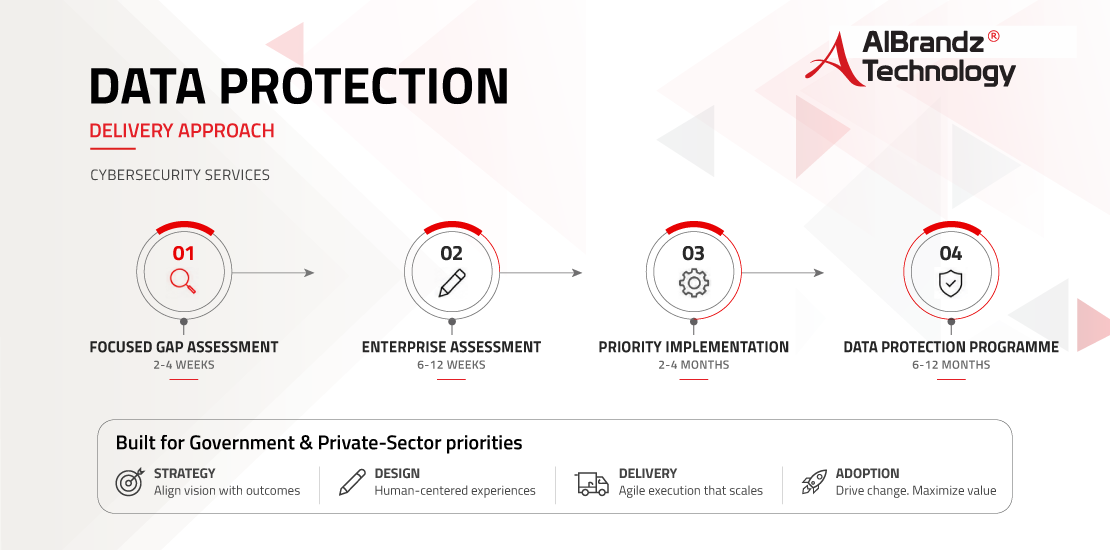
Focused gap assessment
Selected processes, systems or data categories with prioritised findings. The stage includes stakeholder review, documented decisions and confirmation of the inputs required for the next phase.
Enterprise assessment
Inventory, data mapping, policy and control review across multiple functions. The stage includes stakeholder review, documented decisions and confirmation of the inputs required for the next phase.
Priority implementation
Policies, processes, access, retention, supplier and evidence improvements. The stage includes stakeholder review, documented decisions and confirmation of the inputs required for the next phase.
Data protection programme
Organisation-wide governance, technology controls, training and monitoring. The stage includes stakeholder review, documented decisions and confirmation of the inputs required for the next phase.
Discuss your data protection requirements with Albrandz Technology and request a tailored GCC delivery plan.
Benefits of Data Protection
- Replaces fragmented spreadsheet packs with a consistent and accessible management view.
- Highlights trends, exceptions and underperformance without requiring users to analyse raw data.
- Shortens monthly and weekly reporting cycles through automated refresh and reusable models.
- Improves accountability by connecting KPIs with targets, owners and supporting detail.
- Creates governed definitions and validation rules so decision-makers can trust the resulting insight.
- Reduces recurring manual reporting and supports faster performance review across locations or functions.
Who Needs Data Protection?
- Executive teams requiring concise strategic, operational or portfolio performance reporting.
- PMOs and project organisations monitoring schedule, cost, risk, contracts and progress.
- Finance, sales, HR, procurement and customer-service functions with recurring management reports.
- Organisations using Power BI but lacking governed models, consistent design or reliable refresh.
- Public-sector entities requiring reliable KPIs, management reporting and evidence-based planning.
- Private enterprises seeking stronger commercial, financial or operational decision support.
How Much Time Is Needed for BI Dashboards?
Delivery time depends on scope, data and system readiness, stakeholder availability, procurement requirements, security reviews, integrations and approval cycles. Indicative delivery ranges are:
- Dashboard discovery (1-2 weeks): Delivery range subject to confirmed scope, inputs, approvals and resource availability.
- Single dashboard (3-6 weeks): Delivery range subject to confirmed scope, inputs, approvals and resource availability.
- Dashboard suite (6-12 weeks): Delivery range subject to confirmed scope, inputs, approvals and resource availability.
- Enterprise BI rollout (3-9 months): Delivery range subject to confirmed scope, inputs, approvals and resource availability.
The final schedule is confirmed after discovery and scope validation. Government programmes may require additional time for tender procedures, governance approvals, security assessment, data classification, hosting decisions and formal acceptance.
Data Protection
Click below to learn more about our services and solutions.